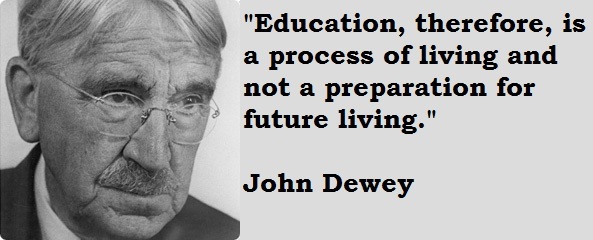
For John Dewey, Education is Life Itself
Before I start with my entry, kindly check out this video first because it embodies what Pragmatism is all about.
Source: youtube
In pragmatism, experiential learning is very much the pedagogical approach that best fits how it should be lived out and taught. It prioritizes the importance of our experiences and how we can share them with others to create the possible solutions for our problems. To simply put it, the premium is on how we learn from our experiences to live a better life.
For a teacher who values pragmatism, he/she has to be willing enough to exhaust his/her efforts in teaching the students about life. Ironically, the way to do it is not through the very traditional, "I teach and you just learn from me" method. In fact, in pragmatism, the teacher has to be patient enough to allow his students to commit mistakes that they can learn from. And based from experience, this is easier said than done. For me, personally, it is quite difficult to allow my students to just make mistakes and to trust the natural process that they can eventually learn from them. There are instances when they actually end up not learning from their mistakes and even end up committing worse mistakes. And yet, this is the type of gamble that a pragmatist would go for. Why is this the case? I think it is because of the possibility of a greater reward that the process can eventually yield.
We have to remember that in pragmatism, the goal is to solve human problems through incorporating past experiences. There is high regard for history and in practicality. So, the only way to attain these things mentioned is to actually allow people to experience things themselves. The more they experience, the better for them.
Now, this is where the dilemma comes in for the teacher. How does he set the line for his students when it comes to experiencing things? In reality, this is very tricky because the teacher has to establish a balance between when to allow his students and when not to allow his students to do certain things. The failure to do so will be most likely be detrimental to the students especially if they end up committing something really grave and there is no more turning back. As a teacher, can you just easily tell them that it is all part of life and they might as well just live with it? And what if, as a teacher, you knew, deep down, that you could have prevented it especially if you had been more strict and rigid about things. Of course, any compassionate teacher would be heavily bothered by that thought. As a teacher, the last thing that I would like to happen is seeing my students suffer just because of my own negligence. This, for me, is the reason why I do not feel as comfortable embarking on too much pragmatism. There is a saying that one should never leave anything to chance. And in pragmatism, it is quite inevitable to leave some things to chance and that is the difficult part about it.
Am I saying that pragmatism is not effective? Of course not. Yet, I do want to point out that it is indeed difficult to be an effective pragmatic teacher. There will always be risks involved. No amount of professional judgement can take away the fact that there will be times when a teacher cannot fully foresee the eventual effects of actions, especially negative ones, that students will be allowed to do. And sometimes, it may be a little too late to remedy something.
Still, the teacher who would teach with pragmatism as his fundamental core, would also enjoy the benefits of seeing students see beyond the school and the classroom. Just imagine the scenario of the students thanking the teacher for teaching them about life. In fact, I personally, remember my teachers who were "Life Teachers" than those who were just merely brilliant with their subject matter. The sharing of life experiences is something that anyone can relate to. One may end up not experiencing it personally. Yet, the actual time to listen and reflect on it always provides an opportunity for learning something new. There were many instances when I would go home from class remembering the experiences shared by my teacher or my classmates than the actual lesson that was taught. Or sometimes, I got to remember the lesson because of the experiences that were shared with it. In this regard, it is truly valuable. And I think, it would be best for all teachers to have that inner "life teacher" in them for it encompasses something greater than any subject matter or lesson that a teacher can impart to his or her students. It touches on the concept of life and how one can battle through it. The greatest thing about it is that one does not even have to embrace pragmatism to do so. He/ she just has to be open enough to learn from his/ her life experiences and be willing enough to share them to others.
If education, according to Dewey, is life itself, then the real concept of how we should go about learning should never be based on grades or whether we did something extraordinarily brilliant. The only real basis should be on how well one lived his life through its ups and downs to make a difference in the lives of other people. As the saying goes, "Life isn't about the destination but the journey that gets us there."


No comments:
Post a Comment